

“I always wanted to go to university,” Zinny says. “Towards the end of high school, with more and more challenges, the pathway was looking less likely. But through some alternate routes it still managed to happen.”
His one-year postgraduate course complements his work in the social impact sector. Subjects include how to best measure and evaluate impact, social investment and corporate responsibility.
“The overarching thing is just learning about how to have a positive social impact,” Zinny explains. “There have been lots of great leaders who are currently working in the social impact sector that have done this course and being able to follow in their footsteps and be one myself is amazing.”
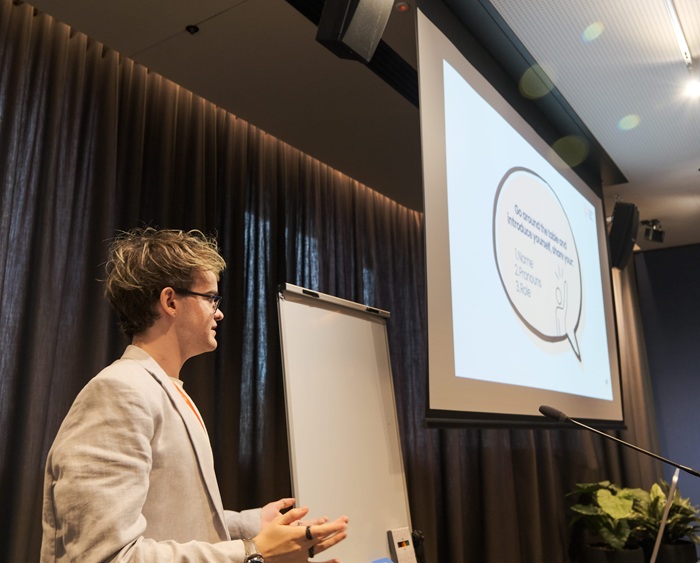
Making youth participation more accessible
Zinny’s interest in social impact is closely connected to his own experiences.
“I have faced plenty of systemic inequities in my own life,” he says. “The main goal is to shift those systems so that no one else falls through the same cracks.”
He is the founder of Hunt for Change, a nonprofit focused on improving access to youth participation opportunities.
Youth participation includes young people contributing to advisory groups, co-designing workshops, involvement in government or third-sector decision-making, and much more. Zinny explains there are already many such opportunities available, but knowledge of them is not reaching young people who are disconnected from existing networks.
“Currently in the sector there’s no easy entry point for young people to get into youth participation, which leads to a lot of the sector hearing from the same voices,” he says.
He points to young people who may be disengaged from school or dealing with other challenges.
“They don’t even know youth participation is a thing,” he says.
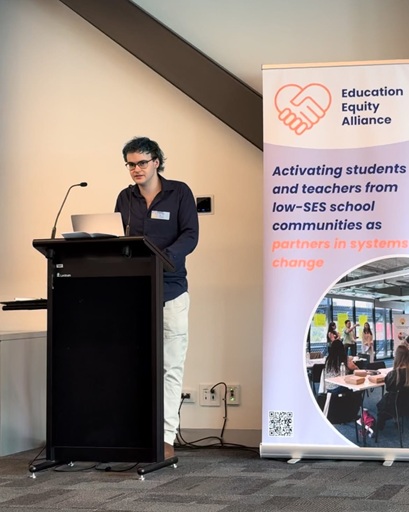
Hunt for Change acts as a centralised hub for young people and organisations to find and share youth participation opportunities. Importantly, many of these roles are paid.
“It’s all about enabling equitable access to these opportunities, making sure that everyone, no matter their background, can take a seat at the table,” Zinny says.
The initiative currently has a team of seven volunteers, as well as a steering committee made up of charity executives.
“I really thought that someone would have done this by now,” Zinny says of the idea. “It’s just such a clear problem. It’s an easy thing to back.”
Finding a balance between work, study and life
Alongside his studies, Zinny works as a Student Voice Lead at the Education Equity Alliance, and also holds around a dozen advisory, committee and leadership roles across the social impact sector.
These include roles with the Youth Affairs Council Victoria, the Black Dog Institute, the Victorian Mental Illness Awareness Council, Growing Minds Australia, and Children and Young People with Disability Australia, among others.
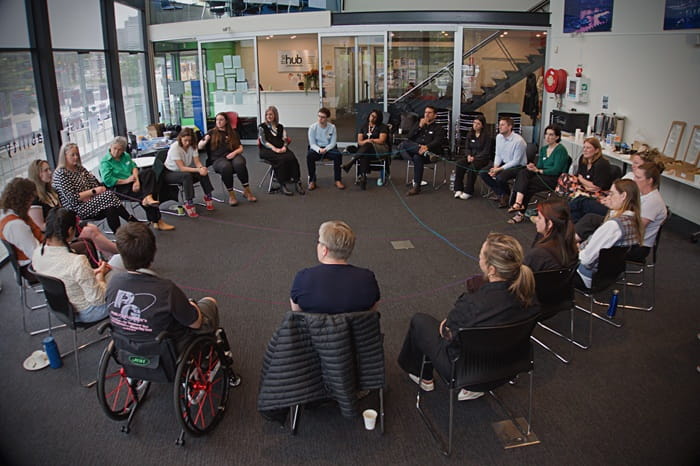
“It’s difficult to find a balance. I’m trying to navigate it,” he says.
His university classes are held on Fridays and Saturdays, with study fitting around his work and other commitments.
“I usually work on Hunt for Change from 9am to 5pm, and then study will happen between 5pm and 9pm,” he says. “Most days I’ll have a committee meeting or advisory meeting or board meeting, so then study will happen after that.
“Sometimes I’ll just come over and co-exist with a friend. They’ll read a book and I’ll keep working. And they’ll drag me away from my desk eventually. I’ve now started taking board and committee meetings from the gym so that I don’t miss that!”
Despite the workload, he is content.
“Because life has been so stressful in the past – with managing being homeless and doing Year 12 and lawyers and psychology and all of that stuff – when all of that isn’t happening, life feels quiet. Like I have more time than I did back then, the amount of stress I hold now is incomparable to back then.”
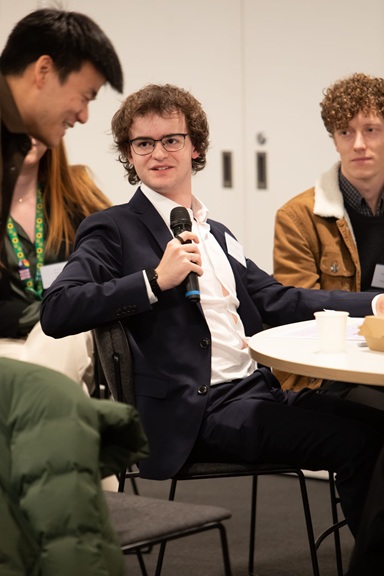
What the scholarship means
Having experienced homelessness, financial security was an important consideration when deciding whether to undertake further study.
“I remember living off of like $50 a week because Centrelink was being a pain and kept making mistakes,” he says. “The refuge that I was at would give you $50 per week and that’s all you got.”
Those experiences influence how he thinks about money.
“Money has been so ingrained in me to be something that causes stress,” he says. “Of course now I’m in a much better position. I’m working now, but it still is such a protective factor to not have it be something I need to stress over.”
Having a scholarship has further reduced that pressure.
“With a scholarship, it takes some of that load off the young person,” Zinny says. “I’m not putting myself in a worse position, I’m not causing myself financial stress by studying.”
The scholarship will contribute significantly towards his living expenses, as well as study costs and other essentials.
“It covers a year of expenses for me,” he says. “I don’t really spend money on anything at all apart from food, rent, boardgames sometimes. I don’t indulge in much at all.”
He plans to use his studies and experience in the social impact sector to continue working on the issues that matter to him.
“A lot of my work is focused on just doing some good, or leaving the world better than you found it,” he says. “A lot of my life purpose surrounds that.”
About the Tertiary Scholarship Program
The Sisters of Charity Foundation awards tertiary scholarships to young people from out-of-home care backgrounds (foster care, kinship care, residential care etc).
Financial support helps recipients afford university or TAFE study expenses (course fees; textbooks; technology; and attending workshops, networking events and internships) as well as the cost of living on their own with no parental support. The scholarship lets them focus on their studies, rather than having to hold down multiple jobs or work full-time hours.
Explore by Topic
asylum seekers & refugees (8) babies & children (12) Community Care (4) Community Grants (58) COVID-19 (11) disability (5) domestic violence (8) education (9) elderly (2) employment assistance (10) environment (3) events (11) First Nations (3) food relief (8) Gifts in Wills (1) grief (4) health care (9) homelessness (10) housing (19) human trafficking (10) legal support (1) media (4) mental health (17) mentoring (10) modern slavery (11) news (21) out-of-home care (33) prisoners (1) Providence House (4) rural & regional (13) scholarships (34) substance abuse (5) tax tips (1) unemployment (3) volunteering (10) young people (43)
How We Help
Each year we’re able to make a difference to thousands of people across the country with funds generously donated by compassionate Australians. We support initiatives that focus on benefiting the disadvantaged, marginalised and socially isolated people in our community.


